Many custom options...


And formats...



Sell in Chinese / Japanese...
Buy a Sell calligraphy wall scroll here!
Personalize your custom “Sell” project by clicking the button next to your favorite “Sell” title below...
Sell

塞爾 is the name Sell in Chinese (Mandarin).
Sell

セル is the name Sell in Japanese Katakana.
Note: Because this title is entirely Japanese Katakana, it should be written by a Japanese calligrapher.
Islam
(phonetic version)
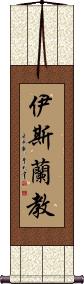
伊斯蘭教 both means and sounds like “Islam” in Mandarin Chinese.
The first three characters sound like the word “Islam,” and the last character means “religion” or “teaching.” It's the most general term for “Islam” in China. The highest concentration of Muslims in China is Xinjiang (the vast region in northwest China that was called The East Turkistan Republic until 1949 and is sometimes called Chinese Turkistan, Uyghuristan). Here you will find Uygurs, Kazakhs, Kyrgyz, and others that are descendants of Turkmen (possibly mixed with Persians and Arabs). Many of their ancestors were traders who traveled the silk road to buy and sell spices and silk and exchange other goods from the Orient and the Middle East.
I spent some time in Xinjiang and got to know this community. They are strong people who can endure much. They are friendly and love to have a good time. I was a stranger but was treated by villagers (near China's border with Afghanistan) as if I was a good friend.
However, I have heard that it's best not to cross them, as in this land, the law is the blade, and everything is “eye for an eye.” The Chinese government has little control in Xinjiang, with almost no police officers except in the capital of Urumqi (so it's a 60-hour roundtrip train ride to seek the aid of law enforcement in most cases).
While few seem devout, there are at least small mosques in every village. And you will never see a man or woman outside without a head covering.
It should be noted that these people are all citizens of China, but they are officially of the Caucasian race. A visit to Xinjiang will change your idea of what it means to be Chinese.
These search terms might be related to Sell:
Go Kan Ryu
Go With the Flow
Go-Dan / 5th Degree Black Belt
Labor Union / Trade Union
Push or Knock
Release / Let Go
The Game of Weiqi / Weichi / Go
Not the results for Sell that you were looking for?
Below are some entries from our dictionary that may match your Sell search...
| Characters If shown, 2nd row is Simp. Chinese |
Pronunciation Romanization |
Simple Dictionary Definition |
銷售 销售 see styles |
xiāo shòu xiao1 shou4 hsiao shou |
More info & calligraphy: Sales |
キャラハン see styles |
kyarahan キャラハン |
More info & calligraphy: Callahan |
估 see styles |
gù gu4 ku ko |
used in 估衣[gu4 yi5] Guess, estimate. |
售 see styles |
shòu shou4 shou |
(bound form) to sell; to retail; (literary) to carry out (a plan or intrigue etc) |
市 see styles |
shì shi4 shih shouichi / shoichi しょういち |
market; city; municipality (administrative unit); (literary) to trade; to buy and sell goods (n,n-suf) city; (place-name, surname) Shouichi A market, a fair, an open place for public assembly. |
沽 see styles |
gū gu1 ku ko |
to buy; to sell to sell |
盤 盘 see styles |
pán pan2 p`an pan ban ばん |
tray; plate; dish; (finance) (bound form) market prices; (computing) (bound form) disk; to coil (a rope, pigtail etc); to check; to examine; to investigate; to transfer; to sell (property); to shift; to move (something big and heavy); classifier for things resembling a plate or dish; classifier for coils; classifier for games or matches (chess, table tennis etc) (1) board (in shogi, go, chess, etc.); (2) (phonograph) record; disc; disk; (suffix noun) (3) board; panel; plate; (personal name) Ban A dish, plate; round, to coil, wind up; to go about, travel, convey; to inquire about, interrogate. Translit. pa, ba, bha, va; cf. 般, 半, etc. |
糶 粜 see styles |
tiào tiao4 t`iao tiao seri せり |
to sell (grain) (irregular okurigana usage) (1) competing; competition; (2) auction |
詅 see styles |
líng ling2 ling |
to sell |
販 贩 see styles |
fàn fan4 fan |
to deal in; to buy and sell; to trade in; to retail; to peddle |
賒 赊 see styles |
shē she1 she sha |
to buy or sell on credit; distant; long (time); to forgive To buy or sell on credit; to borrow; slow, remiss, shirk. |
賣 卖 see styles |
mài mai4 mai mai |
to sell; to betray; to spare no effort; to show off or flaunt To sell. |
酤 see styles |
gū gu1 ku ko |
to deal in liquors To deal in spirits, or alcoholic liquor. |
銷 销 see styles |
xiāo xiao1 hsiao shō |
to melt (metal); to cancel; to annul; to sell; to expend; to spend; pin; bolt; to fasten with a pin or bolt To melt metal, dissolve, dispel, dissipate, spend, cancel, end. |
鬻 see styles |
yù yu4 yü |
to sell, esp. in strained circumstances |
交售 see styles |
jiāo shòu jiao1 shou4 chiao shou |
(of a farmer) to sell one's produce to the state as stipulated by government policy |
代銷 代销 see styles |
dài xiāo dai4 xiao1 tai hsiao |
to sell as agent; to sell on commission (e.g. insurance policies); proxy sale (of stocks) |
俏貨 俏货 see styles |
qiào huò qiao4 huo4 ch`iao huo chiao huo |
goods that sell well |
倒弄 see styles |
dǎo nong dao3 nong5 tao nung |
to move (things around); to buy and sell at a profit (derog.) |
倒騰 倒腾 see styles |
dǎo teng dao3 teng5 tao t`eng tao teng |
to move; to shift; to exchange; to buy and sell; peddling |
做空 see styles |
zuò kōng zuo4 kong1 tso k`ung tso kung |
to sell short (finance) |
內銷 内销 see styles |
nèi xiāo nei4 xiao1 nei hsiao |
to sell in the domestic market; domestic market |
冠る see styles |
kamuru かむる kaburu かぶる |
(transitive verb) (1) (kana only) to put on (one's head); to wear; to have on; to pull over (one's head); to crown (oneself); (2) (kana only) to be covered with (dust, snow, etc.); to pour (water, etc.) on oneself; to dash on oneself; to ship water; (3) (kana only) to bear (e.g. someone's debts, faults, etc.); to take (blame); to assume (responsibility); to shoulder (burden); (4) to overlap (e.g. sound or color); (5) to be similar; to be redundant; (v5r,vi) (6) to be fogged (due to overexposure, etc.); (7) to close; to come to an end; (8) to get a full house; to sell out; (9) (archaism) to blunder; to bungle; to fail; (10) (archaism) to be deceived |
出づ see styles |
izu いづ |
(v2d-s,vi) (1) (archaism) to leave; to exit; to go out; to come out; to get out; (2) (archaism) to leave (on a journey); to depart; to start out; to set out; (3) (archaism) to move forward; (4) (archaism) to come to; to get to; to lead to; to reach; (5) (archaism) to appear; to come out; to emerge; to surface; to come forth; to turn up; to be found; to be detected; to be discovered; to be exposed; to show; to be exhibited; to be on display; (6) (archaism) to appear (in print); to be published; to be announced; to be issued; to be listed; to come out; (7) (archaism) to attend; to participate; to take part; to enter (an event); to play in; to perform; (8) (archaism) to be stated; to be expressed; to come up; to be brought up; to be raised; (9) (archaism) to sell; (10) (archaism) to exceed; to go over; (11) (archaism) to stick out; to protrude; (12) (archaism) to break out; to occur; to start; to originate; (13) (archaism) to be produced; (14) (archaism) to come from; to be derived from; (15) (archaism) to be given; to get; to receive; to be offered; to be provided; to be presented; to be submitted; to be handed in; to be turned in; to be paid; (16) (archaism) to answer (phone, door, etc.); to get; (17) (archaism) to assume (an attitude); to act; to behave; (18) (archaism) to pick up (speed, etc.); to gain; (19) (archaism) to flow (e.g. tears); to run; to bleed; (20) (archaism) to graduate |
出る see styles |
izuru いずる |
(v1,vi) (1) (ant: 入る・はいる・1) to leave; to exit; to go out; to come out; to get out; (v1,vi) (2) to leave (on a journey); to depart; to start out; to set out; (v1,vi) (3) to move forward; (v1,vi) (4) to come to; to get to; to lead to; to reach; (v1,vi) (5) to appear; to come out; to emerge; to surface; to come forth; to turn up; to be found; to be detected; to be discovered; to be exposed; to show; to be exhibited; to be on display; (v1,vi) (6) to appear (in print); to be published; to be announced; to be issued; to be listed; to come out; (v1,vi) (7) to attend; to participate; to take part; to enter (an event); to play in; to perform; (v1,vi) (8) to be stated; to be expressed; to come up; to be brought up; to be raised; (v1,vi) (9) to sell; (v1,vi) (10) to exceed; to go over; (v1,vi) (11) to stick out; to protrude; (v1,vi) (12) to break out; to occur; to start; to originate; (v1,vi) (13) to be produced; (v1,vi) (14) to come from; to be derived from; (v1,vi) (15) to be given; to get; to receive; to be offered; to be provided; to be presented; to be submitted; to be handed in; to be turned in; to be paid; (v1,vi) (16) to answer (phone, door, etc.); to get; (v1,vi) (17) to assume (an attitude); to act; to behave; (v1,vi) (18) to pick up (speed, etc.); to gain; (v1,vi) (19) to flow (e.g. tears); to run; to bleed; (v1,vi) (20) to graduate; (v1,vi) (21) (vulgar) to ejaculate; to cum; (place-name) Izuru |
出售 see styles |
chū shòu chu1 shou4 ch`u shou chu shou |
to sell; to offer for sale; to put on the market |
出盤 出盘 see styles |
chū pán chu1 pan2 ch`u p`an chu pan |
to sell up; to wind up a business |
出脫 出脱 see styles |
chū tuō chu1 tuo1 ch`u t`o chu to |
to manage to sell; to dispose of something (by selling); to get property off one's hands; to find excuses (to get off a charge); to extricate sb (from trouble); to vindicate; to become prettier (of child) |
出賣 出卖 see styles |
chū mài chu1 mai4 ch`u mai chu mai |
to offer for sale; to sell; to sell out; to betray |
割肉 see styles |
gē ròu ge1 rou4 ko jou |
to cut some meat; to cut off a piece of flesh; (fig.) (coll.) to sell at a loss |
Click here for more Sell results from our dictionary
The following table may be helpful for those studying Chinese or Japanese...
| Title | Characters | Romaji (Romanized Japanese) | Various forms of Romanized Chinese | |
| Sell | 塞爾 塞尔 | sāi ěr / sai1 er3 / sai er / saier | sai erh / saierh | |
| Sell | セル | seru | ||
| Islam | 伊斯蘭教 伊斯兰教 | yī sī lán jiào yi1 si1 lan2 jiao4 yi si lan jiao yisilanjiao | i ssu lan chiao issulanchiao |
|
| In some entries above you will see that characters have different versions above and below a line. In these cases, the characters above the line are Traditional Chinese, while the ones below are Simplified Chinese. | ||||

Successful Chinese Character and Japanese Kanji calligraphy searches within the last few hours...



