Many custom options...


And formats...



Plank in Chinese / Japanese...
Buy a Plank calligraphy wall scroll here!
Personalize your custom “Plank” project by clicking the button next to your favorite “Plank” title below...
Plank

普蘭克 is the name Plank in Chinese (Mandarin).
Plank

プランク is the name Plank in Japanese Katakana.
Note: Because this title is entirely Japanese Katakana, it should be written by a Japanese calligrapher.
The one who retreats 50 paces mocks the one to retreats 100
The pot calls the kettle black
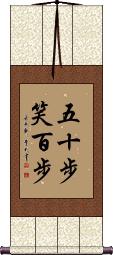
五十步笑百步 is a Chinese proverb that means the one who retreats 50 paces mocks the one who retreats 100 paces.
During the Warring States Period of what is now China (475 - 221 B.C.), the King of Wei was in love with war. He often fought with other kingdoms just for spite or fun.
One day, the King of Wei asked the philosopher Mencius, “I love my people, and all say I do the best for them. I move the people from famine-stricken areas to places of plenty and transport grains from rich areas to the poor. Nobody goes hungry in my kingdom, and I treat my people far better than other kings. But why does the population of my kingdom not increase, and why does the population of other kingdoms not decrease?”
Mencius answered, “Since you love war, I will make this example: When going to war, and the drums beat to start the attack, some soldiers flee for their lives in fear. Some run 100 paces in retreat, and others run 50 steps. Then the ones who retreated 50 paces laugh and taunt those who retreated 100 paces, calling them cowards mortally afraid of death. Do you think this is reasonable?
The King of Wei answered, “Of course not! Those who run 50 paces are just as timid as those who run 100 paces.”
Mencius then said, “You are a king who treats his subjects better than other kings treat their people, but you are so fond of war that your people suffer from great losses in battle. Therefore, your population does not grow. While other kings allow their people to starve to death, you send your people to die in war. Is there any difference?”
This famous conversation led to the six-character proverb shown here. It serves as a warning to avoid hypocrisy. It goes hand-in-hand with the western phrase, “The pot calls the kettle black,” or the Biblical phrase, “Before trying to remove a splinter from your neighbor's eye, first remove the plank from your own eye.”
These search terms might be related to Plank:
Not the results for Plank that you were looking for?
Below are some entries from our dictionary that may match your Plank search...
| Characters If shown, 2nd row is Simp. Chinese |
Pronunciation Romanization |
Simple Dictionary Definition |
さばに see styles |
sabani さばに |
plank-built fishing boat (Okinawa) |
フランク see styles |
puranku プランク |
More info & calligraphy: Frank |
スパイダーマン see styles |
supaidaaman / supaidaman スパイダーマン |
More info & calligraphy: Spider-Man |
板 see styles |
bǎn ban3 pan ban ばん |
board; plank; plate; shutter; table tennis bat; clappers (music); CL:塊|块[kuai4]; accented beat in Chinese music; hard; stiff; to stop smiling or look serious (1) board; plank; (2) sheet (of metal); plate (of glass); pane; slab; (3) (See 俎板・1) cutting board; chopping board; (4) (abbreviation) (usu. as 板さん) (See 板前・1,板場・いたば・2) chef (esp. of high-end Japanese cuisine); cook; (5) stage (i.e. at a theatre); (personal name) Ban A board; a board struck for calling e. g. to meals. |
牏 see styles |
tóu tou2 t`ou tou |
short board; plank |
鋪 铺 see styles |
pù pu4 p`u pu minezawa みねざわ |
plank bed; place to sleep; shop; store; (old) relay station mine tunnel; mine shaft; mineshaft; (personal name) Minezawa |
厚板 see styles |
atsuita あついた |
(1) thick board; plank; (2) steel plate (with a thickness of at least 3 mm); (3) heavy brocade cloth; (4) Elaphoglossum yoshinagae (species of fern) |
小板 see styles |
kosaka こさか |
small plank; piece of wood; (surname) Kosaka |
張板 see styles |
hariita / harita はりいた |
plank used to dry wet clothes or paper |
敷板 see styles |
shikiita / shikita しきいた |
floorboard; plank |
木板 see styles |
mù bǎn mu4 ban3 mu pan mokuhan; kiita / mokuhan; kita もくはん; きいた |
slab; board; plank; CL:張|张[zhang1],塊|块[kuai4] (1) wooden board; (2) (もくはん only) (See 木版・1) woodblock; woodblock printing |
板子 see styles |
bǎn zi ban3 zi5 pan tzu itago いたご |
board; plank; bamboo or birch for corporal punishment ship plank; (personal name) Itago |
板材 see styles |
itazai いたざい |
wooden board; plank |
板状 see styles |
banjou / banjo ばんじょう |
(adj-no,n) board-shaped; plank-shaped; sheet-shaped |
板畳 see styles |
itadatami いただたみ |
(1) tatami mat with a wooden plank for a core (used in tokonoma, etc.); (2) (See 板敷) wooden floor |
板舟 see styles |
itafune; itabune いたふね; いたぶね |
(1) plank raft; (2) display stand for seafood (Edo period) |
桟道 see styles |
sandou / sando さんどう |
plank path (on a steep mountainside, cliff face, etc.); walkway |
棧徑 栈径 see styles |
zhàn jìng zhan4 jing4 chan ching |
a plank road (built on trestles across the face of a cliff) |
棧道 栈道 see styles |
zhàn dào zhan4 dao4 chan tao |
plank walkway constructed on the face of a cliff; (archaic) elevated passageway connecting the upper levels of adjacent towers |
棧閣 栈阁 see styles |
zhàn gé zhan4 ge2 chan ko |
plank road built along the side of a cliff; CL:條|条[tiao2] |
横板 see styles |
yokoita よこいた |
(1) crosscut plank; (2) rear part of a noh stage |
橋板 see styles |
hashiita / hashita はしいた |
plank of a bridge; bridge plank |
船板 see styles |
funaita ふないた |
(ship or shipbuilding) timber or plank; (surname) Funaita |
野面 see styles |
nobu のぶ |
(1) (surface of) field; plain; (2) unworked surface of (quarried) stone; (rough) surface of plank; (place-name) Nobu |
魚板 鱼板 see styles |
yú bǎn yu2 ban3 yü pan manaita まないた |
{Buddh} large flat wooden plank shaped like a fish, struck like a gong at temple to indicate time of day; (place-name) Manaita The wooden fish in monasteries, beaten to announce meals, and to beat time at the services. |
仕切り板 see styles |
shikiriita / shikirita しきりいた |
(1) partition board; plank used as a partition; (2) board used in a ship to prevent the cargo from moving around |
平板支撐 平板支撑 see styles |
píng bǎn zhī chēng ping2 ban3 zhi1 cheng1 p`ing pan chih ch`eng ping pan chih cheng |
plank (exercise) |
四肢支撐式 四肢支撑式 see styles |
sì zhī zhī chēng shì si4 zhi1 zhi1 cheng1 shi4 ssu chih chih ch`eng shih ssu chih chih cheng shih |
low plank (yoga pose) |
秦嶺蜀棧道 秦岭蜀栈道 see styles |
qín lǐng shǔ zhàn dào qin2 ling3 shu3 zhan4 dao4 ch`in ling shu chan tao chin ling shu chan tao |
the Qinling plank road to Shu, a historical mountain road from Shaanxi to Sichuan |
Variations: |
sabani; sabani サバニ; さばに |
(from Ryuku lang.) plank-built fishing boat (Okinawa) |
Click here for more Plank results from our dictionary
The following table may be helpful for those studying Chinese or Japanese...
| Title | Characters | Romaji (Romanized Japanese) | Various forms of Romanized Chinese | |
| Plank | 普蘭克 普兰克 | pǔ lán kè pu3 lan2 ke4 pu lan ke pulanke | p`u lan k`o pulanko pu lan ko |
|
| Plank | プランク | puranku | ||
| The one who retreats 50 paces mocks the one to retreats 100 | 五十步笑百步 | wù shí bù xiào bǎi bù wu4 shi2 bu4 xiao4 bai3 bu4 wu shi bu xiao bai bu wushibuxiaobaibu | wu shih pu hsiao pai pu wushihpuhsiaopaipu |
|
| In some entries above you will see that characters have different versions above and below a line. In these cases, the characters above the line are Traditional Chinese, while the ones below are Simplified Chinese. | ||||

Successful Chinese Character and Japanese Kanji calligraphy searches within the last few hours...



