Many custom options...


And formats...



Link in Chinese / Japanese...
Buy a Link calligraphy wall scroll here!
Personalize your custom “Link” project by clicking the button next to your favorite “Link” title below...
Link

林克 is the name Link in Chinese (Mandarin).
Link

リンク is the name Link in Japanese Katakana.
Note: Because this title is entirely Japanese Katakana, it should be written by a Japanese calligrapher.
Leong

梁 is the Cantonese and Hokkien surname Leong, meaning beam or bridge.
Other surname characters such as 龍 (dragon) and 連 (to link or connect) can also romanize as Leong.
Guide / Help / Cooperate
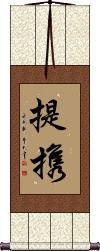
提携 varies a bit depending on which language you are reading it in.
提携 means to guide and help (younger people) in Chinese.
Cooperation or “working in concert” in Korean.
And cooperation, tie-up, joint business, and link-up in Japanese.
Karma Connection
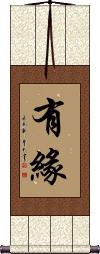
有緣 means: related; brought together by fate; same karma; those who have the cause, link, or connection.
有緣 is a common word in Chinese but usually only used in the context of Buddhism in Japanese.
Buddhists will say this refers to those that are influenced by and responsive to the Buddha.
Bond
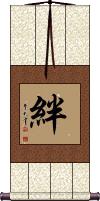
This Kanji represents a bond, as in the bond between mother and daughter, father and son, family ties, or a family bond.
絆 is the kind of character that says, no matter what happens (difficult times), we have this bond that cannot be broken.
If you go to the Japanese dictionary, the definition is the bonds (between people), (emotional) ties, relationship, connection, link, tether, or fetters.
Read this before ordering...
This Kanji is best if your audience is Japanese. While this is also a Chinese character, it has a completely different meaning in Chinese (it means to hinder or stumble in Chinese).
it’s
a very rare character in Korean Hanja but does mean bond in Korean (used in Korean words for certain kinds of glue and sticking plaster).
The Mysterious Bond Between People
The invisible force that brings people together forever
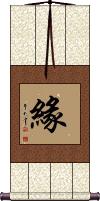
緣 represents the fate that brings and bonds people together.
緣 is a complicated single character. It can mean a lot of different things depending on how you read it.
In Japanese, it can mean fate, destiny, a mysterious force that binds two people together, a relationship between two people, bond, link, connection, family ties, affinity, opportunity, or chance (to meet someone and start a relationship). It can also mean “someone to rely on,” relative, reminder, memento, or the female given name, Yori.
It's the same in Chinese, where it's defined as cause, reason, karma, fate, or predestined affinity.
In the Buddhist context, it's Pratyaya. This is the concept of indirect conditions, as opposed to direct causes. It's when something happens (meeting someone) by circumstance or a contributing environment. Instead of a direct cause or act, it is a conditioning cause without direct input or action by the involved people.
Occasionally, this character is used in a facetious way to say hem, seam, or edge of clothing. In this case, it's the seam that brings or holds the clothing together.
 Note: Japanese will tend to use the variant of this Kanji shown to the right. If you want this version (and are ordering this from the Japanese master calligrapher), click on the Kanji at the right instead of the button above.
Lingering Mind
Zanshin
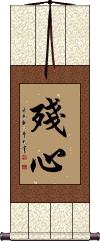
First off, 殘心 should only be used in the context of Japanese martial arts. In Chinese, it's a rather sad title (like a broken heart). In Chinese, the first character alone means destroyed, spoiled, ruined, injured, cruel, oppressive, savage, incomplete, or disabled. However, in Japanese, it's remainder, leftover, balance, or lingering.
The second character means heart, mind, soul, or essence in both languages.
殘心 is one of the five spirits of the warrior (budo) and is often used as a Japanese martial arts tenet. Under that context, places such as the Budo Dojo define it this way: The spirit of zanshin is the state of the remaining or lingering spirit. It is often described as a sustained and heightened state of awareness and mental follow-through. However, true zanshin is a state of focus or concentration before, during, and after the execution of a technique, where a link or connection between uke and nage is preserved. Zanshin is the state of mind that allows us to stay spiritually connected, not only to a single attacker but to multiple attackers and even an entire context; a space, a time, an event.
 In modern Japan (and Simplified Chinese), they use a different version of the first character, as seen to the right. Click on this character to the right instead of the button above if you want this modern Japanese version of lingering mind / zanshin.
These search terms might be related to Link:
Bond
Family Bond / Family Ties
Fudoshin Association
Goju Association
Isshin Association / Isshin Association
Japanese Karate Association
Karma Connection
Relationship
Sisterhood / Association of Women
Sisterhood / Sisters Relationship
The Mysterious Bond Between People
Woman’s Association
The following table may be helpful for those studying Chinese or Japanese...
| Title | Characters | Romaji (Romanized Japanese) | Various forms of Romanized Chinese | |
| Link | 林克 | lín kè / lin2 ke4 / lin ke / linke | lin k`o / linko / lin ko | |
| Link | リンク | rinku | ||
| Leong | 梁 | liáng / liang2 / liang | ||
| Guide Help Cooperate | 提携 | tei kei / teikei | tí xié / ti2 xie2 / ti xie / tixie | t`i hsieh / tihsieh / ti hsieh |
| Karma Connection | 有緣 有缘 | uen | yǒu yuán / you3 yuan2 / you yuan / youyuan | yu yüan / yuyüan |
| Bond | 絆 绊 | kizuna | bàn / ban4 / ban | pan |
| The Mysterious Bond Between People | 緣 / 縁 缘 | en | yuán / yuan2 / yuan | yüan |
| Lingering Mind | 殘心 残心 | zan shin / zanshin | cán xīn / can2 xin1 / can xin / canxin | ts`an hsin / tsanhsin / tsan hsin |
| In some entries above you will see that characters have different versions above and below a line. In these cases, the characters above the line are Traditional Chinese, while the ones below are Simplified Chinese. | ||||

Successful Chinese Character and Japanese Kanji calligraphy searches within the last few hours...



