Many custom options...


And formats...



Not what you want?
Try other similar-meaning words, fewer words, or just one word.
Feel free to email me with your request. If it's easy, I'll translate it for free and add it to this database of calligraphy for you.
6 Characters in Chinese / Japanese...
Buy a 6 Characters calligraphy wall scroll here!
Gay Pride
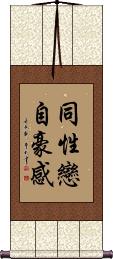
同性戀自豪感 or “Gay Pride” is a new idea in China. It's so new, that we may have just started the movement by translating this phrase.
If they ever do start having gay pride parades in China, my best guess is that these 6 characters will constitute the term they use to title the parade/movement.
Who knows, maybe in 10 years they will have a pride parade march straight past Tian'anmen Square on Chang An Street (the main drag in Beijing).
This in-stock artwork might be what you are looking for, and ships right away...
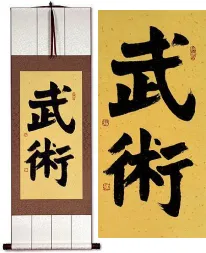
Gallery Price: $168.00
Your Price: $92.88
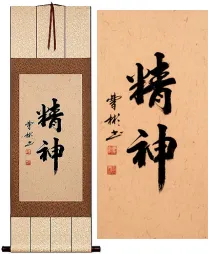
Gallery Price: $150.00
Your Price: $82.88
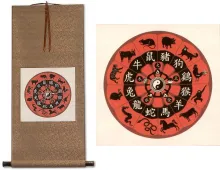
Gallery Price: $80.00
Your Price: $28.88
Gallery Price: $80.00
Your Price: $29.88
Gallery Price: $200.00
Your Price: $111.88

Gallery Price: $36.00
Starting at: $20.00
Not the results for 6 characters that you were looking for?
Below are some entries from our dictionary that may match your 6 characters search...
| Characters If shown, 2nd row is Simp. Chinese |
Pronunciation Romanization |
Simple Dictionary Definition |
一 see styles |
yī yi1 i moto もと |
More info & calligraphy: One(numeric) one (chi: yī); (female given name) Moto eka. One, unity, monad, once, the same; immediately on (seeing, hearing, etc.). |
切 see styles |
qiè qie4 ch`ieh chieh setsu せつ |
More info & calligraphy: Che(noun or adjectival noun) (1) (See 切に,切なる) eager; earnest; ardent; kind; keen; acute; (interjection) (2) (abbreviation) (also きり) (See 切る・3) OFF (on switch) To cut, carve; a whole; urgent; the 反切 system of spelling, i. e. the combination of the initial sound of one Chinese word with the final sound of another to indicate the sound of a third, a system introduced by translators of Buddhist works; v. 反. |
草 see styles |
cào cao4 ts`ao tsao hajime はじめ |
More info & calligraphy: Cao / Kusa / Grass(1) draft; rough copy; (2) (abbreviation) (See 草書) highly cursive style (of writing Chinese characters); grass style; (female given name) Hajime Grass, herbs, plants; rough; female (of animals, birds, etc. ). |
鳥 鸟 see styles |
niǎo niao3 niao yanadori やなどり |
More info & calligraphy: Bird(1) bird; (2) bird meat (esp. chicken meat); fowl; poultry; (surname) Yanadori A bird. |
情報 情报 see styles |
qíng bào qing2 bao4 ch`ing pao ching pao jouhou / joho じょうほう |
More info & calligraphy: Intelligence / Information-Gathering(1) information; news; report; intelligence; (2) information (data contained in characters, signals, code, etc.); (3) informatics (as a subject) |
スマイリー see styles |
sumairii / sumairi スマイリー |
More info & calligraphy: Smiley |
丂 see styles |
kǎo kao3 k`ao kao |
"breath" or "sigh" component in Chinese characters |
丆 see styles |
xx xx5 xx |
one of the characters used in kwukyel (phonetic "myeon"), an ancient Korean writing system |
丨 see styles |
shù shu4 shu |
vertical stroke (in Chinese characters), referred to as 豎筆|竖笔[shu4 bi3] |
丵 see styles |
zhuó zhuo2 cho |
thick grass; "bush" component in Chinese characters |
丶 see styles |
zhǔ zhu3 chu |
"dot" radical in Chinese characters (Kangxi radical 3), aka 點|点[dian3] |
丷 see styles |
bā ba1 pa |
"eight" component in Chinese characters; old variant of 八[ba1] |
丿 see styles |
piě pie3 p`ieh pieh |
radical in Chinese characters (Kangxi radical 4), aka 撇[pie3] |
乇 see styles |
zhé zhe2 che |
"blade of grass" component in Chinese characters |
乊 see styles |
xx xx5 xx |
one of the characters used in kwukyel (phonetic "ho"), an ancient Korean writing system |
乙 see styles |
zhé zhe2 che kinoto きのと |
turning stroke (in Chinese characters), aka 折[zhe2] (noun or adjectival noun) second in rank; second sign of the Chinese calendar; (surname, female given name) Kinoto |
乚 see styles |
yà ya4 ya |
component in Chinese characters; old variant of 毫[hao2]; old variant of 乙[yi3] |
乥 see styles |
xx xx5 xx |
one of the characters used in kwukyel (phonetic "hol"), an ancient Korean writing system |
亅 see styles |
jué jue2 chüeh |
"vertical stroke with hook" radical in Chinese characters (Kangxi radical 6), aka 豎鉤|竖钩[shu4 gou1] |
亠 see styles |
tóu tou2 t`ou tou |
"lid" radical in Chinese characters (Kangxi radical 8) |
亪 see styles |
xx xx5 xx |
one of the characters used in kwukyel (phonetic "ye"), an ancient Korean writing system |
亻 see styles |
rén ren2 jen |
"person" radical in Chinese characters (Kangxi radical 9) |
仒 see styles |
xx xx5 xx |
one of the characters used in kwukyel (phonetic "eo" or "sya"), an ancient Korean writing system |
伊 see styles |
yī yi1 i yoshi よし |
(old) third person singular pronoun ("he" or "she"); second person singular pronoun ("you"); (May 4th period) third person singular feminine pronoun ("she"); (Classical Chinese) introductory particle with no specific meaning; (preceding a noun) that (abbreviation) (See 伊太利・イタリア) Italy; (personal name) Yoshi He, she, it; that; translit. i, ai, ṛ; cf. 壹, 彝 and 意; for the long ī the double characters 翳吚 and 伊伊 are sometimes used. |
伩 see styles |
xìn xin4 hsin |
variant of 信[xin4] (originally meant as part of the second round of simplified Chinese characters) |
儿 see styles |
rén ren2 jen |
variant of 人[ren2]; "person" radical in Chinese characters (Kangxi radical 10), occurring in 兒, 兀, 兄 etc |
冂 see styles |
jiōng jiong1 chiung maki まき |
radical in Chinese characters (Kangxi radical 13), occurring in 用[yong4], 同[tong2], 網|网[wang3] etc, referred to as 同字框[tong2 zi4 kuang4] (female given name) Maki |
冖 see styles |
mì mi4 mi |
"cover" radical in Chinese characters (Kangxi radical 14), occurring in 軍|军[jun1], 冠[guan1] etc, known as 禿寶蓋|秃宝盖[tu1 bao3 gai4] or 平寶蓋|平宝盖[ping2 bao3 gai4] |
冫 see styles |
bīng bing1 ping |
"ice" radical in Chinese characters (Kangxi radical 15), occurring in 冰[bing1], 次[ci4] etc, known as 兩點水|两点水[liang3 dian3 shui3] |
匸 see styles |
xì xi4 hsi |
"cover" or "conceal" radical in Chinese characters (Kangxi radical 23) (distinguished from 匚[fang1]) |
Click here for more 6 characters results from our dictionary
The following table may be helpful for those studying Chinese or Japanese...
| Title | Characters | Romaji (Romanized Japanese) | Various forms of Romanized Chinese | |
| Gay Pride | 同性戀自豪感 同性恋自豪感 | tóng xìng liàn zì háo gǎn tong2 xing4 lian4 zi4 hao2 gan3 tong xing lian zi hao gan tongxinglianzihaogan | t`ung hsing lien tzu hao kan tunghsinglientzuhaokan tung hsing lien tzu hao kan |
|
| In some entries above you will see that characters have different versions above and below a line. In these cases, the characters above the line are Traditional Chinese, while the ones below are Simplified Chinese. | ||||

Successful Chinese Character and Japanese Kanji calligraphy searches within the last few hours...



